Monday, April 6, 2020

Tuesday Bible Study (4/7/20)

The Question of Christ's Wills and Energies


The Third Council of Constantinople - 680-681 A.D.
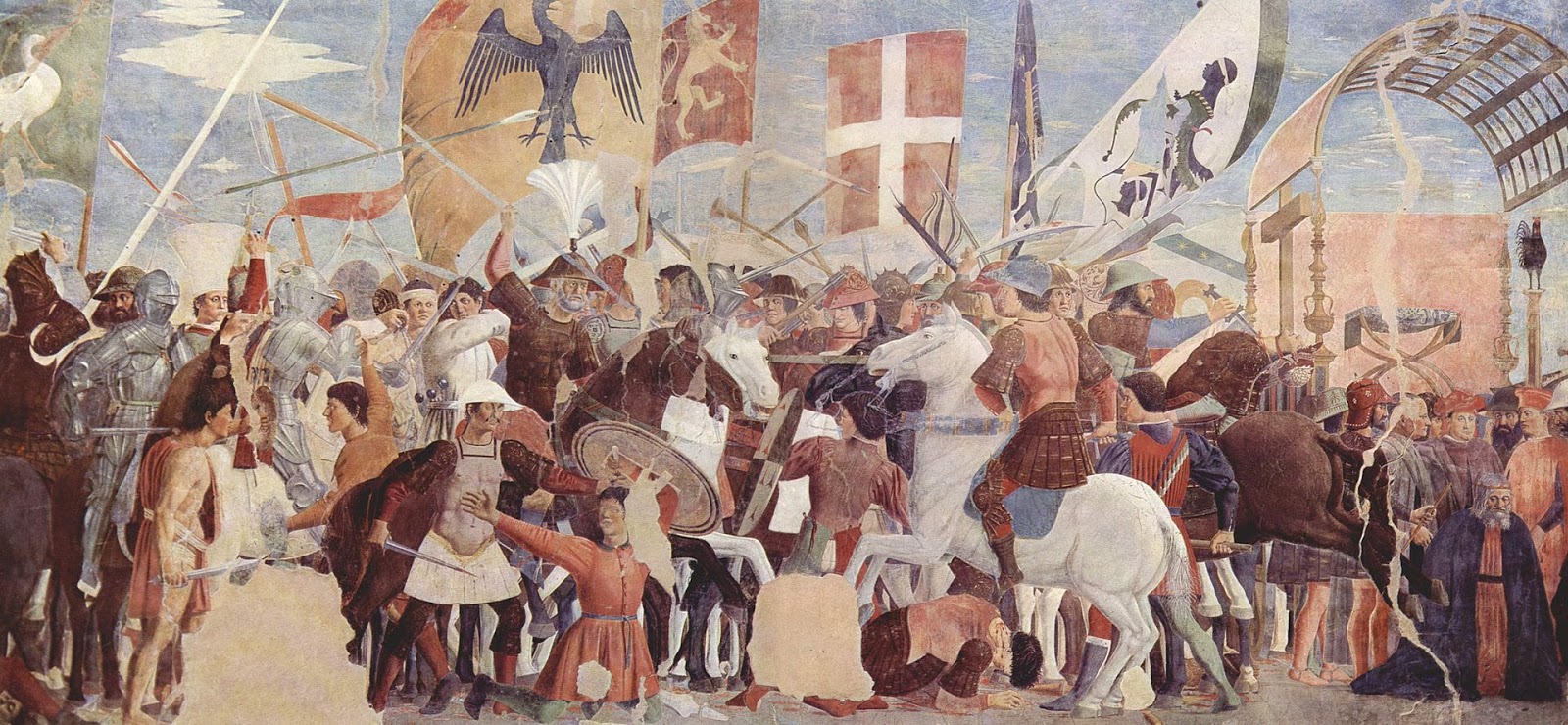
A painting by Piero della Francesca of the  battle between Emperor Heraclius
and the Persians in 628 A.D. Heraclius tried to compromise with non-
Chalcedonian peoples in his realm by propagating monoenergism.
Scriptural Starting Places

Luke 22:42 - "Father, if you are willing, take this cup from me; yet not my will, but yours be done.”

John 4:34 - "My food," said Jesus, 'is to do the will of him who sent me and to finish his work.'"

John 5:30 - "“I can do nothing on my own. As I hear, I judge, and my judgment is just, because I seek not my own will but the will of him who sent me."

John 6:38 - " For I have come down from heaven, not to do My own will, but the will of Him who sent Me."


>> The Greek word for "will" is thelema (θέλημα), which also has the meaning of "desire, pleasure, choice, inclination." The New Testament records that Christ our Lord has a human body, exactly like ours, yet He is fully divine, being the Word of the Father. When the Lord's will is mentioned, it is mentioned in the singular and ascribed to the Person of Christ, not to either His divine nature or human nature.  Christ Himself is ever mentioning His Father's divine will and His desire to obey it perfectly. A debate will arise in the 7th century over the will(s) of Christ in the wake of the Miaphysitism that was now commonly held by Christians throughout Armenia, Syria, Persia, Palestine, and Egypt. The question is, does Christ have one will or two wills? 


Background

The Emperor of the Byzantine Empire had a problem. Finally he had defeated the Persians in several crushing battles between 622 and 627, and had regained vast swaths of territory. On top of that, he had regained the True Cross from the city of Ctesiphon and restored it to Jerusalem.  However, most of the Christians in these newly liberated (or conquered) areas were non-Chalcedonian Miaphysites, meaning they did not share the same Christological views of the Emperor himself and established Byzantine Orthodoxy. Heraclius thought that a commonly held religion would be a unifying force in his empire, but in the face of these conflicting views, what was he to do? 

Aided by Sergius, patriarch of Constantinople, Heraclius attempted to attain a Christological compromise position that would bring together the various religious attitudes of the diverse areas of his empire.  The attempt at unity was aided by a  teaching that Heraclius and Sergius, the patriarch of Constantinople, hoped to popularize called Monenergism. Simply put, it was a compromise position which posited Christ had two natures but only a single energy or activity. Later, this teaching evolved into a teaching on the single activity of his will (thelema).  Heraclius and Sergius thought that this teaching might serve a unifying function in the kingdom by bridging Byzantine Orthodox theology with Miaphysite theology.  Sergius won over the patriarchs of Alexandria and Antioch with this teaching. Yet, beginning in 633, the teaching was opposed by Sophronius of Jerusalem and Maximus. At this time, Sergius sent the Psephos to a theologian of Alexandria, Cyrus, disallowing him and any others from talking about one or two activities (energies) in Christ. The Psephos was then an attempt at ending the conversation, to avoid further controversy. 

In 638 the language about the one energy of Christ evolved into the one will of Christ. Heraclius then issued the Ecthesis (Ἔκθεσις) which attempted to settle the Christological controversy by positing Christ's dual natures always worked through a single will. Sophronius and others rejected this. A contemporary scholar sums up very well the consequences of the Echthesis: "For what Sergius and the emperor had decreed was that there is in Jesus Christ only one will and one truly free and spontaneous activity, the divine activity and will. Granting the existence of a human nature, its activity is completely subordinate to that of the divine; the humanity in the power of the Word is merely a docile instrument which He uses and which is devoid of any initiative of its own" (Leo Donald Davis, 268). 

Maximus Confessor was the key theologian during this time. Fleeing to Carthage and then to Rome in the wake of the Muslim Arab conquest, Maximus was a stout foe of Monothelitism. He put forward the idea that a nature without will and operation is impossible. Christ's two natures therefore imply two wills, though his human will is not our fallen, sinful one (which Maximus calls the gnomic will, from γνώμηgnṓmē, "mind, reason, opinion, judgment"), but rather, our "natural" one which is free of sin, as in Adam and Eve before the Fall. Christ has no fallen will, only an un-fallen one, which always chooses the Good, which is always obeying the divine will. 

By the time of Constans II, emperor of the Byzantine empire, the controversy was still raging, and the emperor released an edict called the Typos in 648. In it he forbade any more discussion on the question of Christ's energies or wills. This was rejected in the West by the Lateran Synod of 649, a synod which Maximus participated in. 

Finally, under the new leadership of Emperor Constantine IV (668-685), a decision was reached to initiate a universal council to decide the issues that had been dividing East and West for some 50 years. 


A mosaic in the Italian city of Ravenna of Christ, saints, and angels.

Heresies

Monoenergism (μονοενεργητισμός): the teaching that preceded Monothelitism and posited Christ has two natures but only a single energy (ἐνέργειᾰ ). Though rather vague, monoenergism was essentially an attempt to reconciled Chalcedonians and non-Chalcedonians in the Byzantine Empire. It was accepted by the patriarchs of Constantinople, Alexandria, and Antioch. Pope Honorius famously accepted it (or at least did not condemn it) in his 635 epistle. 

Monothelitism (μονοθελητισμός ): the teaching that Christ has two natures but only one will. This teaching emerged from Constantinople in 638 as a response to Sophronius' condemnation of Monoenergism as another form of Monophysitism. This view was propagated by the Ecthesis and won widespread approval in the East. Following the death of Honorius, all of the popes in Rome condemned the doctrine. 

Miaphysitism: the non-Chalcedonian position that Christ has a single physis, or nature. Miaphysitism was wide-spread throughout the East. Essentially it posits that the single nature of the Word became enfleshed, fully human, while remaining the Word. Monophysitism is a direct rejection of Chalcedon and implies that Christ has a solitary nature only: the divine

Tritheism: emerging in Alexandria in the 6th century, Tritheism posited that the Three Persons of the Trinity were consubstantial but distinct in their properties. A chief proponent of this view was John Philoponus (c. 490 - c. 570) who was an Aristotelian philosopher of Alexandria and a Monophysite. Essentially Tritheism is any theology which emphasizes or separates the distinctness of each Person at the expense of the unity. 


Pope Honorius I (pope from 625 - 638) initially
supported Monothelitism, though he did not know
what was at stake. He was careful to guard against
the teaching of two contrary wills in Christ.

Key Personages

Emperor Heraclius (reigned 610 - 641): a very successful military commander, Heraclius waged war against the Persian Sassanian Empire and won a series of major victories. Unfortunately, most of his gains were reversed a short time later during the Muslim Arab invasions. Famously, Heraclius re-captured the true cross from the Sassanians in Nineveh and restored it to the Church of the Holy Sepulchre, Jerusalem. During peace time, Heraclius was keen to unite the disparate Christian groups of his vast empire. The theological foundation for unity was the compromise doctrine of Monenergism (later, Monothelitism) formulated by Sergius I. Indeed, for around 40 years there was a rough reconciliation between Armenians, Jacobite (followers of Jacob bar Addai, the so-called "Syriac Christians"), and Egyptian Copts, but this did not last long. 

Sergius I of Constantinople (patriarch from 610 - 638): the architect of Monenergism and Monothelitism which were two attempts at preserving the Chalcedonian distinction of the two natures of Christ while also admitting the single activity of will of Christ. This was more acceptable to the various Monophysite groups in Armenia, Syria, Persia, and Egypt. It was hoped by Heraclius and Sergius that this formulation would unite the empire.


Pope Honorius I (pope from 625 - 638): a controversial figure, Honorius was embroiled into this Christological controversy which he did not fully understand. In a letter to Sergius he writes, "Hence, we confess one will of our Lord Jesus Christ also, because surely our nature, not our guilt, was assumed by the Godhead..." Honorius was careful to preserve the sinless aspect of Christ and was afraid that attributing a human will to him meant also attributing ignorance, sin, and imperfection. Honorius probably did not have the vocabulary to defend his position, as his successor to the papacy points out. Despite this, he was anathematized in the canons of Constantinople III. 

Pope Agatho (pope from 678 to 681):  the pope during the Third Council of Constantinople, Agatho's letter Considerante mihi as well as a synodal letter from the Synod of Rome were read and approved by the council fathers. Agatho wrote in his letter, "When we, however, confess two natures and two natural wills and two natural operations in our one Lord Jesus Christ, we affirm that they are not against or contrary to one another... nor are they as if separated in two persons or subsistencies.  Rather we affirm that just as there are two natures in our Lord Jesus Christ, so does he have two natural wills and two operations, namely, divine and human; the divine will and operation he has in common from eternity with his co-essential Father; the human he has temporarily from us with our assumed nature." 


Sophronius of Jerusalem (c. 560 - 638): a monk and ascetic, friend of John Moschus the chronicler of the monks of Palestine. He was a staunch defender of Dyothelitism (the teaching of the two wills of Christ) and famously viewed the Muslim invaders of Palestine as "unwitting representatives of God's inevitable chastisement of weak and wavering Christians." All that survive of his writings is the so-called synodical letter, written to other bishops in the East and warning of the heresy of Monothelitism. It was read aloud at the council almost 50 years after Sophronius's death. 


Maximus Confessor (c. 580 - 662): erudite, well-travelled, and fearless, Maximus picked up the mantle of orthodoxy from Sophronius and defended Dyothelitism until his tragic death. He was born into a well-to-do family in Constantinople, and was a chief secretary to Emperor Heraclius before becoming a monk. In the face of Muslim conquest, he left the East for Carthage and then for Rome. Under Constans II, Maximus was called to Constantinople and punished for his views. His tongue was cut out of his mouth and his right hand was severed. He died later in exile on the Black Sea.  Many of his writings are still extant. Maximus argued that in the Incarnation Christ "accomplishes in all truth the true human destiny that he himself had predetermined as God, and from which man had turned: he unites man to God." 


Pope Agatho depicted in a Byzantine service book, c. 1000 A.D.

The Council Itself

It opened on Nov. 7, 680 with 43 bishops present. Eighteen separate sessions would meet over the next 10 months, with the final session ending Sept. 16, 681. 

Papal legates (representatives) demanded the clergy of Constantinople to explain the doctrines of Monenergism and Monothelitism. Macarius of Antioch (a Monothelite) did not aid his side's case when he produced volumes of extracts from Church Fathers which were corrupted and twisted out of context. In the eighth session, the patriarch of Constantinople, George, compared Patristic texts in Constantinople to the texts that the legates presented in favor of two wills. He was convinced, and confessed two wills. 

When it was discovered that Macarius and his assistant had falsified Patristic texts in an attempt to make their heresy sound orthodox, they were deposed. A new patriarch of Antioch was accepted in Macarius's place. 

At one point, a Monothelite priest named Polychronius attempted to prove the validity of his party's position by raising a dead man to life. It failed. Another priest named Constantine proposed a view that upon the cross Christ had abandoned his human will so that only the divine will remained. These two men were removed from the priesthood, their views condemned. 

Eventually all patriarchs of Constantinople from 610 to 666 were condemned for their heretical views, and Pope Honorius (d. 638) was condemned for his Monenergist views presented in his letter. 

The final Christological teaching espoused by the council fathers was this: "We likewise proclaim in [Christ], according to the teaching of the holy Fathers, two natural volitions or wills and two natural actions, without division, without change, without separation, without confusion. The two natural wills are not - by any means - opposed to each other as the impious heretics assert; but his human will is compliant; it does not resist or oppose but rather submits to his divine and almighty will. For, as the wise Athanasius says, it was necessary that the will of the flesh move itself, but also that it be submitted to the divine will; because, just as his flesh is said to be and is the flesh of God the Word, so too the natural will of his flesh is said to be and is God the Word's very own, as he himself declares: 'I have come down from heaven, not to do my own will, but the will of him who sent me.' He calls the will of his flesh his own will because the flesh also has become his own."

The council also confessed two actions (energies) in Christ, "without division, without change, without separation, without confusion, namely, a divine action and a human action... For we do not in any way admit one natural action of God and the creature, so as neither to raise to the divine essence what is created nor to lower the sublime nature to the level proper to creatures. For we know that both the miracles and the sufferings belong to one and the same, according to the different natures of which he consists and in which he has his being..." 


Aftermath

This council would have far-reaching ramifications for the Vatican I doctrine of papal infallibility, given that Honorius I is specifically condemned for his heretical views. This was a condemnation the papal legates knew and accepted at the council, 680 - 681. 

Lutheran scholastics in the late 16th and early 17th centuries would further develop the Chalcedonian and Constantinopolitan definitions. The technical idea here is called the communicatio idiomatum - the "communication of attributes (properties)."  Lutheran theologians organized the attributes into three genera ("classes, kinds"): 

- genus idiomaticum (idioma = "attribute"): the properties of one nature, human or divine, is transferred or applied to the whole Person. There is not a "fleshly Christ" and a "heavenly Christ," for this would be Nestorianism.  An example of this genus in action would be something like Peter says in 4:1 of his letter: "Christ suffered in the flesh," etc. 

- genus apotelesmaticum (apotelesma = "work"): the actions of Christ belong to the whole Person of Christ. One or the other nature does not "shut off" during a particular action. The Apostles do not speak of the "divine nature" becoming a ransom, but of the Christ Himself.  An example could be what Paul writes in 1 Timothy 2:5 - "[T]here is one man Jesus Christ who gave himself as a ransom for all..." 

- genus maiestaticum (māiestās = "dignity, prestige"): the human nature of Christ is clothed and magnified by the attributes of the divine nature. An example of this would be Paul's words in Philippians 2:10 - "at the name of Jesus every knee should bow in heaven and earth..." Another example would be the Lord's Supper: by eating the flesh and blood of Christ we are also partaking of His very divinity. 

If you are interested in learning more about Orthodox Lutheran Christology (which is essentially Cyrillian, check out: https://concordiatheology.org/2011/01/christology-illustrated-from-the-ct-vault/ 

Mosaic of Christ at Sant'Apollinaire Nuovo, Ravenna, Italy (6th century)


Tuesday, March 31, 2020

Tuesday Bible Study (3/31/20)

The Question of Islam


Scriptural Bearings

Matthew 5:44 - But I say to you, Love your enemies and pray for those who persecute you. 

2 Peter 2:1-3 - But false prophets also arose among the people, just as there will be false teachers among you, who will secretly bring in destructive heresies, even denying the Master who bought them, bringing upon themselves swift destruction.  And many will follow their sensuality, and because of them the way of truth will be blasphemed.  And in their greed they will exploit you with false words. Their condemnation from long ago is not idle, and their destruction is not asleep.

1 Peter 4:12-14 - Beloved, do not be surprised at the fiery trial when it comes upon you to test you, as though something strange were happening to you. But rejoice insofar as you share Christ's sufferings, that you may also rejoice and be glad when his glory is revealed. If you are insulted for the name of Christ, you are blessed, because the Spirit of glory and of God rests upon you

>>Summary: Jesus Himself tells his disciples that hard times will come to them, but that they must love, forgive, and even pray for their enemies. Remember that since Abel, the son of the first man, the righteous have suffered and died. In the centuries and centuries of Islamic rule, many Christians in the Orthodox, Oriental, and Syriac Christian groups would suffer discrimination, persecution, and martyrdom. It's important to note at this point, that by the 7th century, different Christian churches (and traditions) had emerged in the world. In the West, there is the more monolithic Latin or Roman Catholic Church. In the East there is Orthodoxy, the state religion of the Byzantine Empire, which holds to all of the ecumenical councils. There are then two groups that split off from Orthodoxy beginning in the early 5th century: the Oriental Orthodox and the Nestorian, also called the 'Church of the East.' The Oriental Orthodox church was formed after the fall-out from disagreement and political wrangling after the Council of Chalcedon (451 A.D.). These Christians, primarily in areas like Armenia, Egypt, Mesopotamia, Syria, and Ethiopia, were (and are, there are around 70 million in the world today) miaphysites, that is, adherents to a kind of Cyrillian understanding of the one, unified nature of Jesus that is simultaneously fully divine and fully human. The Church of the East, which spread from Persia all the way to Mongolia, China, and India, were primarily Nestorian, rejecting the Council of Ephesus (431 A.D.) and accepting as dogma the belief that Christ's two natures were distinct and separate. This is an oversimplification, as modern-day views in the Church of the East (which has about 1.5 million members worldwide) hold Christological views which don't necessarily accept Nestorius and all of his teachings. Note that in what follows, I heavily rely on Derek Cooper's book Twenty Questions that Shaped World Christian History (Fortress). 


Overview 

Around the year 570 a person was born who would change the world forever. This man was Muhammad, who would soon take political control of Arabia. Immediately after his death his followers launched a conquest of vast swaths of the Middle East, Africa, and India - areas with large Christian populations and deeply-rooted Christian culture. 

The Church of the East - a branch of Christianity with a geographical reach from Syria to China - lost leaders, churches, and monasteries to the new Muslim powers which quickly overran the Byzantine and Persian Empires. The speed of it all was stunning. As scholar Judith Herrin puts it, "In a single decade, the Arabs had occupied Syria, Palestine, and the richest province of Egypt, including the Christian Holy Places of Jerusalem and Bethlehem." 

Arabs under Umar, the leader of the Rashidun Caliphate, captured Jerusalem in 634 and built a wooden mosque atop the temple mount. This later was replaced by the very famous Dome of the Rock, modeled after the Church of the Holy Sepulchre and directly opposing the Christian dogma of the Trinity and the Sonship of Christ by its gilded writing on the exterior which reads, "There is no god but Allah alone. [He] did not beget." 

Muslim armies quickly and easily captured the major Christian center of Antioch, and in 640 they captured the most important city in Syriac Christendom: Edessa (modern-day Homs, Iraq). Two years later the central city in Armenian Christianity was captured, and in 645, the important Eastern Christian city of Ctesiphon fell. During this time, Christians had to pay a special tax called a jizyah. Often those who did not want to pay it were imprisoned and persecuted, or, they were convinced that conversion to Islam was the right course of action. 

As the new way of life unfolded, Christian monks, priests, and leaders felt the need to write sermons and books that made sense of such an unthinkable situation. 

Some writers, such as Anastios of Sinai and John of Damascus, read the Koran and knew personally many Muslim scholars and leaders. John gave a well-researched and organized response to Islam in several books. Others were misinformed about Islamic beliefs and wrote or spoke off-hand, condemnatory remarks that have survived history. Muslims were often called "Ishmaelites," as the Arabians were believed to be descendants of Ishmael, the son of Abram through Hagar, the servant girl. Every major Christian writer and leader considered Muhammad to be a false prophet and Muslims to be heretics, not members of a different "religion."  


Timeline

622 A.D. - Muhammad and his followers travel to Medina and establish an Islamic State

630 A.D. - Muhammad enters Mecca and its citizens accept Islam

633 A.D. - Muhammad dies - his friend Abu Bakr, becomes the first caliph. Others (Shia Muslims) believed Muhammad's cousin, Ali ibn Abi Talib, was the first rightful caliph.

634 A.D. - Caliphs invade Syria and Palestine, conquering much of the Levant

639-642 A.D. - Muslim armies conquer Egypt

645 A.D. - Seleucia-Ctesiphon - one of the most important cities for the Church of the East (picture below) - falls to invaders

647 - 742 A.D. - Muslim conquest of the Maghreb - North Africa

711-714 - Under Muhammad bin Qasim, Muslim conquest of Indian subontinent begins

711 - 721 - Invasion of Hispania (Spain) and Gaul (France) by Ummayad Caliphate
1864 photograph of Taq Kasra in Ctesiphon

Key Personages

Muhammad (c. 570 - 632 A.D.): Arab religious leader and founder of Islam (meaning "submission"), a monotheistic religion. At age 40 he claimed to have been visited by the archangel Gabriel in a cave where he was living in seclusion. Rapidly gathering followers, Muhammad claimed also to have been given the Quran by the angel.  By the time of his death, almost the entire Arabian peninsula had converted to Islam. 

Sophronius of Jerusalem (c. 560 - 638): The head bishop of Jerusalem from 634 until his death. An Orthodox Chalcedonian, Sophronius opposed Monoergism during his lifetime - the teaching that Christ had one energy (in Greek, ἐνέργειᾰ - enérgeia), that is, one active principle or operation. Sophronius was in Jerusalem as it was besieged by Arab forces under Abu Ubaidah. After four months, the Byzantines surrendered. Sophronius signed the the Umariyya Covenant which surrendered the city and gave civil and religious liberty to Christians in exchange for tribute money. 

Hnanisho I (died 698 A.D.): The catholicos (head patriarch) of the Church of the East between 686 and 698. In response to a question from the fifth Caliph Abd al-Malik, the bishop famously said, "[Islam] is a kingdom founded by the sword; and not, like the Christian faith and the old faith of Moses, a faith that is confirmed by divine miracles." The caliph ordered his tongue cut out, but some friends interceded for him. Deposed by an illegitimate usurper, Hnanisho was later thrown off a cliff to die, but he survived. After being nursed back to health he reclaimed his patriarchate. 

Pseudo-Methodius (late 7th c. A.D.): a Syriac Christian writer posing as St Methodius (died 311) who wrote an apocalyptic document (known as the "Apocalypse of Pseudo-Methodius") which influenced eschatological thinking in the following centuries.  In it, Muslims are called "Sons of Ishmael," and the writer notes, "It was not because God loves them that he allowed them to enter the kingdom of the Christians, but because of the wickedness and sin which is performed at the hands of the Christians, the like of which has not been performed in any of the former generations." 

John of Damascus (c. 675 - 749 A.D.): Priest and monk honored as saint and "Doctor of the Church," also regarded as the "last of the Church Fathers." Growing up in Damascus, John lived his adult life in a monastery in Palestine, writing theological and liturgical works. In his important work The Found of Knowledge, John gives a severe critique of Islam. About Muhammad he writes, "There are many other extraordinary and quite ridiculous things in this book which he boasts was sent down to him from God. But when we ask: ‘And who is there to testify that God gave him the book? And which of the prophets foretold that such a prophet would rise up?’—they are at a loss."


Icon of St John of Damascus. Often considered the "last of the Church Fathers,"
John is an important bridge between ancient and medieval thought, as well as
an interesting, early interpreter of Islam.
Quotes

Jacob: "What can you tell me about the prophet?  Jewish Teacher: "He is false, for the prophets do not come armed with a sword." - The Teaching of Jacob

"The godless Saracens entered the holy city of Christ our Lord, Jerusalem, with the permission of God and in punishment for our negligence." - John Moschus, monk and writer

"But the present circumstances are forcing me to think differently about our way of life, for why are wars being fought among us? Why do barbarian raids abound? Why are the troops of the Saracens attacking us?  ... Why are the birds of the sky devouring human bodies? Why have churches been pulled down? Why is the cross mocked? Why is Christ, who is the dispenser of all good things and the provider of this joyousness of ours, blasphemed by pagan mouths so that he justly cries out to us: 'Because of you my name is blasphemed among the pagans.' ... That is why the vengeful and God-hating Saracens, the abomination of desolation clearly foretold to us by the prophets, overrun the places which are not allowed to them, plunder cities, devastate fields, burn down villages, set on fire the holy churches, and overturn the sacred monasteries. ... Moreover, they are raised up more and more against us and increase their blasphemy of Christ and the church, and utter wicked blasphemies against God.  These God-fighters boast of prevailing over all, assiduously and unrestrainably imitating their leaders, who is the devil, and emulating his vanity because of which he has been expelled from heaven and been assigned to the gloomy shades." - Sophronius, patriarch of Jerusalem

"Civilization is now itself being ravaged by wild and untamed beasts whose form alone is human." - Maximus the Confessor

> Other Christian leaders, especially those in the far Eastern churches who had experienced horrible persecution under Persian rule beginning in 226 A.D. with the Sassanians coming to power, experienced Muslims as more benevolent rulers. 

"As for the Arabs, to whom God has at this time given rule over the world, you know well how they act towards us. Not only do they not oppose Christianity but they praise our faith, honour the priests and saints of our Lord, and give aid to the churches and monasteries." - Ishoyahb III


The Etchmiadzin Cathedral, Armenia, seat of the catholicos of
the Armenian Orthodox Church. 

Result

To this very day there is tension, confusion, and misinformation among Christians regarding Muslims, and among Muslims regarding Christians. Though Muslims are no longer considered to be "heretics," but rather, members of an entirely new religion founded by Muhammad, many Christians today consider Islam to be an off-shoot of Eastern forms of Christianity, even showing similarities in theological, social, and sexual views. 

When we get to the First Crusade in 1095, and subsequent wars and conflicts with peoples and nations following Muhammad and the Koran, we run into more trouble and confusion, with atrocities committed by men in the name of the Church and Christ and men in the name of Allah and Muhammad.  The fall of Constantinople to Muslim forces in 1453 was a huge blow to Eastern Christendom and marked the final end of Byzantium. 

There are still today pesky questions today about the relation of the West (which is arguably formed by Christian culture but is no longer "Christian") to the Islamic world. Are we still living in the shadow of the Crusades? Is terrorism such as that practiced by Al-Qaeda and ISIS espoused in the original Islamic documents? Who is Allah in relation to the triune God that Christians proclaim? 

There are doubtlessly many other questions, but this study is to be an introduction to the early challenges Christians in the East faced when Muslims began their wars of conquest. As we can see today, the last 1400 years have seen the steady destruction of Orthodox churches, monasteries, and monuments in places like Iraq, Iran, and N. Africa. Early forms of Christianity in China virtually disappeared in the Middle Ages due to persecution. Early Nestorian Christianity in China is a misunderstood thing today, with lots that scholars simply don't know. As Christian populations in those places have steadily declined, many have emigrated to American cities and planted new congregations. 


This important stele (stone slab) from 781 describes
the mission of Nestorian Christians in China.


Friday, March 27, 2020

A   HOME   BIBLE   STUDY  ~  PSALM 30

 A psalm. A song. For the dedication of the temple. Of David.

● This is usually classified as an individual psalm of praise or thanksgiving for deliverance. 
● It was used at the rededication of the temple in 164 B.C. after Judas Maccabeus defeated Antiochus IV Epiphanes, who had profaned the temple... but was written by David long before that.

1 I will exalt you, O LORD, for you lifted me out of the depths
and did not let my enemies gloat over me.
2 O LORD my God, I called to you for help and you healed me.
3 O LORD, you brought me up from the grave; you spared me from going down into the pit. 


● “exalt” =  means to raise or lift up...to praise 
● “lifted me” = means to draw up or lift up, and was used, among other things, for drawing water from a well 
● Here we have the psalmist responding to being lifted up from a bad situation by lifting up the Lord’s name in praise.
● As well, he rejoices in the fact that he did not have to suffer the humiliation of taunting and mockery from his enemies.
● “healed” = means to heal or to restore to health ... here it could mean a restoration to his proper place after the defeat of his enemies.
● “grave” = Sheol ... the place of the dead
● “pit” = a well or cistern ... here a parallel to “grave” in the first half of the verse
● Here the psalmist expresses thanks and praise that the LORD kept him alive so that he might not be abandoned to the pit––the place of death––the dreadful end.

● Can you think of specific examples in your life where you called out to the LORD...and He delivered you?
● How has God spared us from having to have a “dreadful end”?

4 Sing to the LORD, you saints of his; praise his holy name.
5 For his anger lasts only a moment, but his favor lasts a lifetime;
weeping may remain for a night, but rejoicing comes in the morning.


● “saints” = means kind, merciful, or pious...so here those whose lives display their faith in the LORD and whose actions are shaped by the LORD’s laws... “holy ones”
● “holy” = means sacred––something consecrated for a Godly purpose
● “name” = means remember or remembrance, so this verse would be best translated, “his holy remembrance”––but most translations say “his holy name.” When people remember the things that God has done, they remember His name.
● “anger” = means nostril (like our idea of “flaring nostrils”) ... God’s righteous indignation at sin
● But the psalmist says that God’s anger is but for a moment...but His love and delight are forever.
● weeping or sorrow or fear might trouble us by night, but they evaporate with the rising of the sun
● God might permit us to suffer for a time, but will also bring us relief.

● How did you become one of God’s saints... His holy ones?
● How do you praise/remember God’s name in your day-to-day life?
● Is God’s anger justified? Why or why not?
● Is God’s favor justified? Why or why not?
● Over what things do you find yourself weeping? How can God work rejoicing in them?

6 When I felt secure, I said, "I will never be shaken."
7 O LORD, when you favored me,  you made my mountain stand firm;
but when you hid your face, I was dismayed. 


● In the next several verses, we see the progression in the psalmist’s life ... when he was successful, when he faced adversity, his despair over his situation and his cries for mercy.
● “never be shaken” - things were good...really good and the psalmist thought it would never end.
● The psalmist is remembering a time of prosperity when he thought the good times would never end... totally unprepared for what was to come.
● The psalmist finds himself realizing that all his success and security was a gift from God.
● “hid your face” = means that God distanced himself from the psalmist.  God’s help was nowhere to be found.  The psalmist found himself standing alone.
● “dismayed” = means terrified...the kind of terror that we experience when the ground is suddenly cut out from beneath you.

● How do we often find ourselves living with a false sense of security?
● Who do we often credit for our success?
● Who do we often blame in our times of adversity?
● What security in your life can you give thanks to God for?
● Where did God ultimately hide His face so that you would not need to be “dismayed”?

8 To you, O LORD, I called; to the LORD I cried for mercy:
9 "What gain is there in my destruction, in my going down into the pit?
Will the dust praise you? Will it proclaim your faithfulness?
10 Hear, O LORD, and be merciful to me; O LORD, be my help." 


● “mercy” = means to be gracious
● The psalmist is pleading with God to be gracious or to show him mercy––to lift him from the depths to which he has fallen and to restore him to the prosperous place that he once enjoyed.
● In desperation, the psalmist asks God what good could possibly come from his death. Can his decayed body (dust) give Him praise or declare the good things that God has done?
● The psalmist stops trying to persuade God that He has something to gain by helping the psalmist.  Instead, he throws himself on the mercy of the court.

● Have there been times when it seems that your prayers to God for deliverance have gone unanswered?
● What kind of bargains have you tried with God to get what you want?
● Does God need YOUR praise?
● Why, ultimately, must we recognize that God must deal with us purely and simply by his mercy?
● How does God show us His mercy?

11 You turned my wailing into dancing;
you removed my sackcloth and clothed me with joy,
12 that my heart may sing to you and not be silent.
O LORD my God, I will give you thanks forever. 


● Good news! God heard the psalmist and delivered him by the mercy for which he pleaded!
● “sackcloth” = a rough material made from the hair of goats or camels.  It is the kind of cloth that a person would use for heavy-duty sacks (hence its name) or tents, but its coarse texture is uncomfortable when worn against the skin, making it unsuitable for clothing. 
● People would wear it as a sign of grief or repentance.
● But those rough clothes have been replaced with festival garments for rejoicing!!
● In verse 9, the psalmist implied that if he were allowed to live he would praise God and declare His truth.  Now that Yahweh has saved him, the psalmist intends to sing God’s praises and thank Him––forever.

● What was a time when God did a major reversal in your life – turning your sorrow into joy?
● What kind of response did you have at your good fortune?
● How do you think the disciples would have viewed verse 11 on Easter Sunday?
● How do you find yourself being unable to be silent about God’s goodness to you?
● In what ways can we give thanks to God for all that He has done for us?

In this difficult and challenging time, it can seem that God has changed our privileged and stable lives into ones of pure chaos and uncertainty.  What will our response be? Can we claim that we are undeserving of any of the calamity in which we find ourselves? Can we demand God give us something better? Maybe we can try and bribe Him with our promises of faithfulness and service if He will deliver us. The only thing we can do is repent and cry out for His undeserved mercy.

Thankfully, God has already heard our pleas for mercy...and He has acted. In Jesus Christ, He has delivered us from the consequences of our sins and disobedience and He has taken our punishment upon Himself. In return, He dresses us in the blessings of forgiveness, life and salvation won by our Savior on the cross.  In Word and Sacrament, He freely gives us these gifts and promises us that nothing can ever separate us from His unending love.  May we always thank and praise, serve and obey Him for all He has done for us!

(Thanks to SermonWriter.com for help with the notes on these verses.)

Wednesday, March 25, 2020

Midweek Lent 5 - Sermon on Isaiah 53:1-3

Grace, mercy and peace to you from God our Father and from the Lord and Savior Jesus Christ. Amen.

Tonight, I’d like to introduce you to someone. He was a writer and preacher from the 16th century, and he left an amazing legacy to the Church: no, he’s not Martin Luther, he’s Ignatius of Loyola.

Ignatius was a dashing Spanish soldier with a brilliant career ahead of him, but then he fought in a momentous battle in 1521. During the battle, a cannonball ricocheted off a wall and shattered his leg.  Ignatius was almost killed and he was left with very little hope of survival.

Left convalescing in his father’s castle, he figured that all of his dreams of fame and fortune were forever gone.

Desiring for some way to pass the time, Ignatius figured he would read about the exploits of brave knights and dashing cavaliers - anything that would be cathartic and pleasurable. But all that was available to read was a book on the life of Jesus and a book on the lives of the saints.

As Ignatius read these books, he slowly noticed changes in his heart and mind.  His imagination was “baptized” as he entered into the stories. He imagined he was in Galilee, walking next to Jesus. He imagined he was at the foot of the Cross, holding hands with the Lord’s mother. Day after day Ignatius read the life of Jesus and the lives of the saints. And day after day in his heart and mind he was fasting, praying, proclaiming, and worshiping with his own Lord and these men and women from the past.

It was here, in a kind of hospital room, lying in his bed, that Ignatius converted. As soon as he was well enough to manage a limp, he left his father’s castle to live a new life to the new Leader of his life.

And his life was far from being bleak or boring; Ignatius soon sojourned to part of Spain to live as a cave-dwelling hermit for a time, he made a barefoot pilgrimage to the Holy Land and lived there for a month, and he marched into the pope’s presence in Rome to establish a new religious order called the Society of Jesus, also known as the Jesuits, which exists to this day.

Ignatius wrote a lot on the Christian life, but probably his greatest insight for the worldwide Church was that the thoughts and images that flood the heart every day fall into two categories: desolation and consolation. In desolation, Satan and our sinful flesh tempt us, depress us, and mislead us. In consolation, the Holy Spirit and our sanctified conscience works through Word and Image to save, guide, and comfort.  In all of his writings, there is this recurring invitation to believers to pay attention to their thoughts, imaginations, and feelings - to pay attention, because either the Devil or the Spirit is stirring our heart.

You can learn more about this in an important manual Ignatius wrote called “Spiritual Exercises.” These are exactly what they sound like, a Christian training program to deepen one’s spiritual life and to draw one closer to God.

A central part of the spiritual exercises is the practice Ignatius calls “contemplation,” it’s a slow, attentive way to receive into heart, mind, and imagination the stories, people, and images of Holy Scripture.  It is essentially a way to recognize and welcome the consolations that the Spirit brings to us through Word and story.

Always the ambitious one, Ignatius planned an entire regimen of biblical contemplation, beginning with Adam and Eve, and proceeding through the Ascension of our Lord. When he gets to the Gospels’ narrative on the suffering and death of Jesus, he asks his readers to linger for a long time. In his book on spiritual exercises he outlines what you can do each day to become fully immersed in God’s story.

Tonight, I want you to take some guidance from Ignatius and linger in the stories and images of Jesus. Contemplate them. Receive them with a heart that longs to know God better and love him more deeply.

Tonight before you is the gift of the prophet Isaiah - his fourth Servant Song.

"Who has believed our message and to whom has the arm of the Lord been revealed? 

He grew up before him like a tender shoot, and like a root out of dry ground. 

He had no beauty or majesty to attract us to him, nothing in his appearance that we should desire him. 

He was despised and rejected by mankind, a man of suffering, and familiar with pain. 

Like one from whom people hide their faces he was despised, and we held him in low esteem."

Tonight I don’t have a pep talk. I don’t have Lutheran talking points. I don’t have a heart warming story.  I don’t have a solution to the Coronavirus. During this pandemic which is getting crazier by the day, I can’t give you an answer to your WHY questions.  I can’t give you anything to change the past.  I can’t give you any fix.

I can only give to you the pure, holy, limitless Word of God - the Word which never returns empty, which never fails, which never misleads, and which always transforms us.

So tonight, I invite you to contemplate this Man - the Suffering Servant. Welcome the feelings that come to you. Feelings of pity and love, of worship and thanksgiving. 
Encourage your heart to pay attention to the details of his story, and ask yourself, “What is God bringing to me tonight?  Where in my life does God seek transformation?  How else is He guiding me?”

Ask yourself these questions and any others as we follow our Suffering Servant through the Scriptures.

The Psalmist - “All who see me mock me; they hurl insults, shaking their heads: 'He trusts in the Lord; let the Lord rescue him. Let him deliver him, since he delights in him.’”

And again, “Malicious witnesses rise up; They ask me of things that I do not know.”

Isaiah - “I gave My back to those who strike Me, And My cheeks to those who pluck out the beard; I did not cover My face from humiliation and spitting.”

Zechariah - “[W]hen they look on me, on him whom they have pierced, they shall mourn for him, as one mourns for an only child, and weep bitterly over him, as one weeps over a firstborn.”

Matthew - “They spit in his face and struck him. And some slapped him, saying, ‘Prophesy to us, you Christ! Who is it that struck you?’”

Mark -  “Then some began to spit at him; they blindfolded him, struck him with their fists, and said, "Prophesy!" And the guards took him and beat him.”

Luke -  “Now the men who were holding Jesus in custody were mocking him as they beat him.”

To John -  “When the chief priests and the officers saw him, they cried out, ‘Crucify him, crucify him!”

Paul - “And being found in human form, he humbled himself by becoming obedient to the point of death, even death on a cross.”

Peter - “When he was reviled, he did not revile in return; when he suffered, he did not threaten, but continued entrusting himself to him who judges justly.”

This is quite a picture of the King of Kings, isn’t it? How mysterious God is, that He should save us through this sufferer - this broken, crucified God-Man - this Messiah who comes to us as someone with no beauty or majesty, but only deformity.

His deformity and death gives to us beauty and life.

Saint Augustine meditates on this paradox and writes, “It is Christ’s deformity that gives form to you. For if he had been unwilling to be deformed, you would never have gotten back the form you lost.  So he hung on the cross deformed; but his deformity is our beauty. Therefore in this life let us hold fast to the deformed Christ. What do I mean by the deformed Christ? Far be it from me to glory except in the cross of our Lord Jesus Christ, through whom the world has been crucified to me, and I to the world. That is the deformity of Christ. Have I ever spoken to you about anything except that way? This is the way to believe in the crucifix. We carry the sign of this deformity on the forehead.”

God stooped this low to restore us, to recover His Image in each of us. God took on our human flesh - divinity was joined to humanity - in order to repair our humanity and raise us up to God.  The Word became flesh and the Word died on the cross. One of the Trinity suffered for us. This is something so unthinkable and so ugly, but it has become for us something so beautiful. Carry the cross not only on your foreheads, but in your hearts, and lives, and homes. Carry it especially now, in these uncertain days.  Amen.

A contemporary watercolor of Ignatius of Loyola, from
www.ignatianspirituality.com


Tuesday, March 24, 2020

Tuesday Bible Study (3/24/20)

The Question of Christ's Hypostasis (Person)

God's peace. 

Because of the Coronavirus situation, we are continuing our Immanuel Tuesday morning Bible study via the internet. This post will be the most substantial portion of our study on the Second Council of Constantinople, and a video on our YouTube channel (Immanuel Fairmont), will supplement it. If you can, follow this blog post like our class handout as I teach in the video.  Or, watch the video first, and then read through the handout as review. 

Last week we were introduced to St Benedict of Nursia and his influence on Western Christianity and culture. Today, we're picking up with the fifth ecumenical council - the Second Council of Constantinople (553 A.D.). In this I am heavily indebted to the study by Leo Donald Davis (1983). 

"Second Ecumenical Council" painted by Russian realist Vasily Surikov (1848-1916)

Scriptural Starting Places

Matthew 16:16 - "Simon Peter replied, 'You are the Christ, the Son of the living God.'"

John 1:14 - And the Word became flesh and dwelt among us, and we have seen his glory, glory as of the only Son from the Father, full of grace and truth.

John 17:5 - "And now, Father, glorify me in your own presence with the glory that I had with you before the world existed."

Hebrews 1:3 - "He is the radiance of the glory of God and the exact imprint of his nature, and he upholds the universe by the word of his power. After making purification for sins, he sat down at the right hand of the Majesty on high"

Hebrews 2:14 - "Since therefore the children share in flesh and blood, he himself likewise partook of the same things, that through death he might destroy the one who has the power of death, that is, the devil"

>>> Comments: The New Testament writers were not waging the same battles that theologians and emperors would fight in later centuries. The Gospels are clear that the Word (Logos) became flesh. Precisely how the Word and flesh simultaneously co-existed within the God-Man was not a debate during the first century. We might say, that for these writers, the focus was instead on the why of the Incarnation. Most of the key theologians of the 6th century were in agreement on topics such as the sacraments, tradition, and Holy Scripture. Widespread, schismatic debates on these wouldn't occur until Reformation times.  Where these theologians differed was the issue of how Christ's humanity and divinity related to each other, and how human Jesus was - that is, whether he experienced ignorance and corruptibility. There were many ways to answer the question of Christ's nature(s) and the major figures during these times were not always willing to compromise or even meet face to face. This gave rise to schism and heresy, excommunication and banishment. 


Definitions

- φύσις (physis): “nature, property, form”

- persona (Latin): “mask, character”

- πρόσωπον (prósōpon): “face, visage, mask, appearance, person”


- ὑπόστασις (hupóstasis): “sediment, foundation, existence, essence”

From Wiktionary: Hypostasis = "The essential person, specifically the single person of Christ (as distinguished from his two ‘natures’, human and divine), or of the three ‘persons’ of the Trinity (sharing a single ‘essence’)


-  Θεοτόκος (Theotokos) = “God bearer”

>>> Comments: Definitions are important. It is common for Christians today to talk of "the three Persons of the Trinity" without knowing at all where that vocabulary comes from. It comes from these Christological debates raging in the 5th and 6th centuries. The confusion is how these terms were being used. Cyril of Alexandria used the word nature (physis) when he was actually referring to the person (hypostasis) of Christ Jesus. Monophysites latched onto this and noted that Christ can't have two natures because that would make two Christs - two separate beings. It would take more arguing and theological work to fine-tune the language. Others were so vigilant in denouncing Nestorius that they fell into Eutychianism, while others settled for the language of "enfleshment" to describe how the Word became flesh and can be said to have been "born, suffered, and died" despite being perfect, impassable God. 


The Issue

Since the Council of Chalcedon (451 A.D.) new Christological positions have popped up and new heresies uncovered. It will be remembered that at Chalcedon the bishops rejected the position of Eutyches, an aged abbot operating near Constantinople. He had been teaching that out of Christ's two natures, a new nature emerged.  He adopted this view to be radically opposed to Nestorius, and to emphasize that Christ was not two separate beings (or natures), but one.  In this, Eutyches fell into error himself and argued for something that had not previously existed in the writings of the fathers. 

Eutyches essentially proposed a kind of mingling or confusion of the human and divine in Jesus, where Nestorius proposed two separate natures. Eutyches emphasized the mingling where Nestorius emphasized the separation. Neither was the Orthodox position. 

In the century after this Fourth Ecumenical Council, battles raged across the East on the matter of Christ's nature(s). Monophysites, often close to the thought of Cyril of Alexandria (c. 376 - 444), argued that Chalcedon's definition of two natures in one hypostasis came too close to Nestorius and seemed to create two separate beings. 

To confuse the matter, in 484 Felix of Rome excommunicated Acacius of Constantinople and Acacius excommunicated Felix. The problem was due to Acacius' installation of questionable bishops and his imprisonment of papal legates in Constantinople.  This "schism" lasted until 518; it was yet another marker of bad things to come between Latin West and Orthodox East. 

The events between Chalcedon in 451 and Constantinople II in 553 are extremely complicated. Essentially the problems brewing at this time revolve around ecclesiastical authority and ChristologyConstantinople as the "New Rome" was seeking to exert its political and ecclesiastical influence through the emperor and patriarch, and the various groups and sects in the East were arguing over the nature(s) of Christ. 

During this time the "Theopaschite Formula" was a mark of Chalcedonian orthodoxy: "One of the Trinity suffered and died for us." 


Heretics

"The Three Chapters:" a collection of letters and writings from three deceased theologians: Theodore of Mopsuestia (c. 350 - 428), Theodoret of Cyrus (c. 393 - 458), and Ibas of Edessa (d. 457). These writings were extremely controversial and contained the kernels of Nestorian (or perceived Nestorian) teachings. Justinian I anathematized Theodore and the writings of Theodoret and Ibas. Anathematizing the Three Chapters became a mark of pro-Chalcedonian orthodoxy during this time. The problem is that Chalcedon had restored Theodoret and Ibas into communion with the Church, and Theodore died in communion with the Church, being considered orthodox at the time.

Monophysites (μόνος monos, "single" and φύσις physis, "nature"): the large group of bishops, writers, pastors, and laypeople that emerged after the 451 Council of Chalcedon. Rejecting Leo's Tome, they affirmed that Christ had a single, divine nature which had become human. 

Aphthartodocetists (aka "Phantasiasts," aka "Julianists") (original name in Greek, Ἀφθαρτοδοκῆται, from ἄφθαρτος, aphthartos, "incorruptible" and δοκεῖν, dokein, "to seem"): stemming from Bishop Julian of Halicarnassus, this group believed that Christ was impassable, His flesh incorruptible. His body was not susceptible to natural laws, but in His love, He willed his own death for the sake of mankind. The Julianists were especially active in Lower Egypt. They clashed with the Severians (Monophysites who believed Christ's flesh was corruptible). 

Agnoetes: a group of Severus's followers who strongly opposed the Julianists and concluded that Christ was as ignorant as other men. 

Halacephalites: people who believed that by hanging head down for a number of hours for twenty days, one could become impassable and purified of evil.

Origenists: a very broad label for Christians during this time who were in some way influenced by or committed to Origen of Alexandria's (c. 184 - 253) Neoplatonic teachings. Origenism was condemned sometime before, during, or after the council. Essentially, the tenets that were deemed heretical involved the preexistence of souls and the possibility of demons regaining perfection. It is questionable how much of the real Origen is actually behind these 6th century Neoplatonic ideas. 

Mosaic of Justinian I at San Vitale, Ravenna. Justinian brutally
suppressed Monophysite groups during his reign. 


Personages 

Philoxenus of Mabbug (d. 523): Syriac writer who was one of the principal theologians for Monophysitism. His view was this: "There is no nature without person, just as there is no person without nature. If there are two natures, there must be two persons and two sons." 

Severus of Antioch (c. 459 - 538): the chief theologian of the Monophysite position. As bishop of Antioch, he exerted considerable influence on the monks and leaders in a large area around his see. Severus's books were banned by Justinian I and exiled. For Severus, Christ was one unique, compound being sharing in the essence of God and of man. His basic idea was that Christ is "out of two natures and in one nature." 

Emperor Justinian I (reigned 527 - 565): immensely influential as a statesman, lawmaker, theologian, and builder, Justinian was emperor of the East and took a keen interest in Church matters during his reign. Interestingly, his works on the natures of Christ were considerably influential. Along with the pro-Chalcedonian bishops of his time, his writings also contribute to the official Christological position of the Orthodox Church today. Justinian brutally opposed heretical groups and initiated strong missionary movements on the frontiers of his kingdom. 

Empress Theodora (reigned 527 - 548): wife of Justinian, Theodora was a Monophysite and secretly aided numerous Monophysite leaders. Behind Justinian's back, she was partially responsible for the flourishing of Monophysitism in areas like Syria, Palestine, and Egypt.

Pope Vigilius (served 537 - 555): a supporter of Chalcedon, Vigilius refused to sign the anathema against the Three Chapters. He was summoned to Constantinople by Justinian and appeared in person. Basically imprisoned in Constantinople for eight years, Vigilius eventually condemned the Three Chapters. He died on his return voyage to Rome. 


Mosaic from the Hagia Sophia, Constantinople, depicting the Theotokos with Christ in the centre,
Constantine on her left, and Justinian on her right


The Council

Convened on May 5, 553 at the patriarchal palace of Constantinople, about 160 bishops attended, with no bishops present from Gaul (France) or Italy. Much of the beginning of the council revolved around Pope Vigilius and his refusal to denounce the Three Chapters, which he eventually did. 

The council fathers affirmed the previous four ecumenical councils, noting that they correspond to the four Gospels. In the anathemas, Nestorianism,  Eutychianism, Appolinarianism, and Monophysitism are all cursed. The fathers stressed that Christ's two natures are united unconfusedly with no separation, thus steering between Eutyches and Nestorius. 

The council produced no creed, but affirmed the previous councils and issued anathemas. It also condemned Neoplatonic Origenism. 

The third anathema is important: "If anyone says that the Word of God who did wonders was one and Christ who suffered was another, or says that God the Word was together with Christ who came of woman, or was in him as one in another, but not one and the same our Lord Jesus Christ, the Word of God incarnate and made man, and that the wonders and the sufferings, which he voluntarily endured in the flesh, were of the same, let him be anathema." 

The eighth anathema is also worth quoting: "For when saying that the unique Word was united by hypostasis, we do not mean that there was any mixture of the natures with each other, but rather we think of the Word as united with flesh, each remaining what it is. Therefore Christ is one, God and man, the same consubstantial with the father in Godhead, and the same consubstantial with us in manhood. Equally therefore does the Church of God reject and anathematize those who divide into parts or cut up, and those who confuse the mystery of the divine dispensation of Christ." 

A key position at the council was formulated by Leontius of Jerusalem: "The Word is said to have suffered according to the hypostasis, for within this hypostasis he assumed a passable essence beside his own impassible essence, and what can be asserted of the passible essence can be asserted of the hypostasis." 

Another key position was formulated by Leontius of Byzantium who noted the example of a torch to explain the natures of Christ. A torch is not a stick nor is it a flame, however, it is a stick aflame. The wood partakes of fire and fire partakes of wood. He writes, "It remains, then, that from this examination of the character of substantial union, we should grasp the unmixed identity of deity and humanity, according to the previous examples, gathering a fain image from all these of the truth which is above all things, which shows that one entity is produced out of these, of which I do not care whether you call it Person or hypostasis or indivisible being or substratum, or anything else you may prefer. For the argument has now beaten and put to flight those who separate them in their relationship speaking of dignity or authority or some other relation of divided things, showing that they divide the natures into separate hypostases, and such natures can have no real fellowship or share in an exchange of qualities."


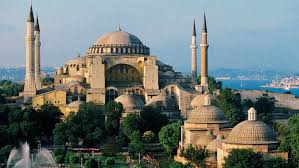
The Hagia Sophia church in modern day Istanbul (built 6th century by Justinian,
minarets added by Muslims after 1453)


The Aftereffect 

Even to this day, Eastern Orthodoxy and Oriental Orthodoxy are split over the matter of Christ's nature(s). The Oriental Orthodox Church is most active in Egypt and Syria, though it is rapidly shrinking. Constantinople II did not expunge Monophysitism, but gave its cause many martyrs. The orthodox imperial church leaders in the Middle East began to be called "Melkites" during this time. The name exists to this day. It is from the Semitic verbal root M-L-K which means "royal, kingly." The Melkites accepted Chalcedon and therefore Constantinople II.

It took several centuries for the Latin West to accept Constantinople II, but it did at the Lateran Synod of 649. 

It would be worthwhile to look at the situation in 6th century Christendom and seek to understand why these battles were raging. What was at stake?  

It's interesting that today our theological battles are raging over the body, sexuality, hell, politics, and environmentalism. What is at stake today? How did we get to this point? 


 So, this list is highly subjective. I haven't read all of these books, and I've also had to eliminate very significant books becaus...